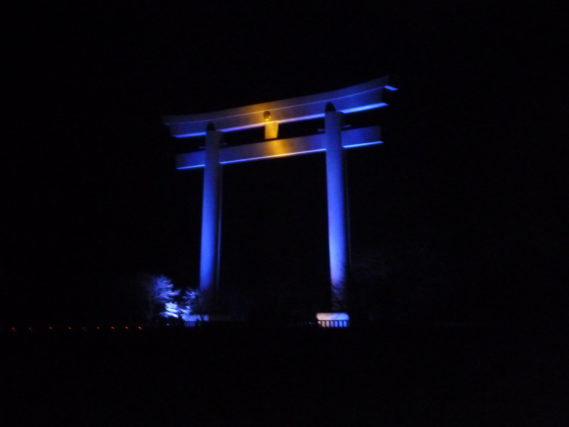
Dangerous Creatures in Kumano (Snakes)

Many of you may say, “I hate snakes,” but there will always come a time when you will encounter them on the Kumano Kodo Trail.
If you dislike snakes physiologically, there is no way around it, but as a guide, I would like you to remember at least a few things about snakes.

Let’s get started.

Pit Viper
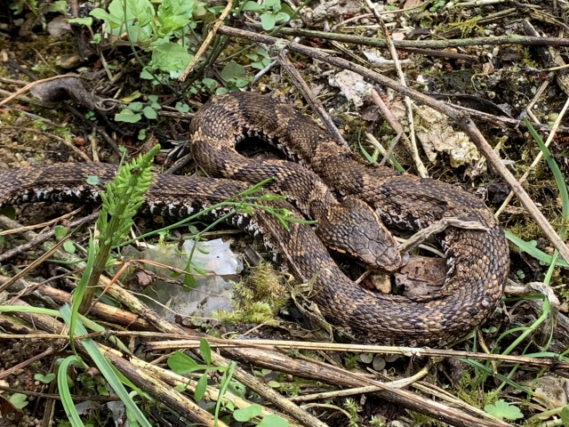
The most important snake to watch out for is the pit viper.
Although pit vipers are considered relatively mild, they will sometimes coil around and jump on you (this is only if you provoke them, though. (This is only in the case of stimulation. It could be the result of an unknowing passerby who “ stimulated” the pit viper.)

I was bitten by a pit viper when I was in elementary school and survived.
…In this case, it was my fault.

On my way home from school, “Boy Wada,” who used to play with snakes whenever I saw them, one day I saw a snake going into the grass.
I grabbed the snake by the tail to see what kind of snake it was, and when I lifted it up, I was bitten on the hand.

At first, the boy Wada did not know that there were poisonous snakes in Japan.
However, after being bitten, I felt a slightly different feeling and realized intuitively that I had been bitten by a “bad snake”.

When I came home, my father had just returned from a break at work. I told him that I had been bitten by a snake and showed him my hand, and he said, “You were bitten by a pit viper. Let’s go to the hospital right away,” and we ended up going to a hospital in Shirahama Town where I lived.

At this time, the middle finger of my right hand where I was bitten had already turned light purple and begun to swell.
We arrived at the hospital, but unfortunately that hospital did not have a serum and we had to go to the neighboring city of Tanabe.

They could have called an ambulance, but for some reason they did not, and my father drove us safely to the next hospital.
In the car, the boy Wada had difficulty breathing and thought to myself as a child, “I might die now”.

Arriving at the hospital, I fainted while being carried to the hospital room in a bed.

When I came to, I did not know if I was alive or if I had already died and was looking at the afterlife.

My right hand, where I was bitten, was swollen all the way up to my shoulder and my short-sleeved uniform shirt was torn by the doctor.

…It would be hard to have such an experience and I never want to do it again.

Then the boy Wada wondered if snakes had traumatized me …

Not at all.

Even now, I can grab snakes other than pit vipers with no problem, and I once killed a pit viper with a stone when I was walking along the Kumano Kodo (Kumano ancient road) because it was coiled around me and was about to attack me.

However, as expected, I don’t want to grab them with my bare hands anymore.

Tiger Keelback

Until recently, it was considered “nonpoisonous,” but it was found that its venomous fangs are located in the back of its mouth, and it was certified as a “ poisonous snake” in the clear.
The characteristic features of this snake are a yellow neck with a red and black block pattern, but since there is a large variation among individuals, some of them are black, and it is sometimes difficult to tell the difference between them.
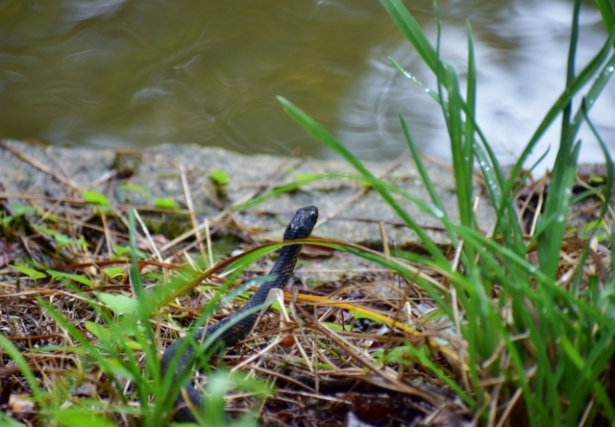
Although they are gentle in nature and there have not been many bite events (although in 2017, a boy in Hyogo was bitten by this), they are still a snake to watch out for.

The poison is also found in the “ jugular gland” on the back of the neck.
This is a defensive poison, and if you grab it, the poison sprays out.
If it gets into the eye, it causes severe pain and, in the worst case, blindness.
This poison seems to be accumulated by eating toads and is not present in individuals that do not eat toads.

What to do when bitten by a snake?

What should you do if you are bitten by a snake?
In the past, I read in a book, “Cut the wound with a knife, and if there is a river nearby, pour out the poison…” However, it is now said that actions such as “cutting the bite spot,” “tying the bitten arm,” and “sucking out the poison” are instead counterproductive.
However, some hospitals recommend “cutting, suctioning, and tying” and it is difficult to judge.

It is said that immediately after being bitten by a poisonous snake, the venom has already dispersed into the tissues of the cells, so sucking out the venom by sucking out the blood will not be as effective as it should be.

…Come to think of it, the boy Wada also survived without such treatment.

So, the best way to do it seems to be to “keep at rest and call the ambulance service immediately”.
If you walk and raise the heart beat, that will speed up the poison’s circulation.
It is also necessary to calm the injured person.
It is important to calm them down and say “I’m fine” so that they do not raise their heart beat due to psychological anxiety.

But in recent years, some have insisted on seeing the doctor as soon as possible, even if it means running, which is a controversial issue.

It is also important to remember what kind of snake bites you and its characteristics.
This is because the way to deal with the bite will depend on the snake that bit you.
In the unlikely event that you are unable to confirm its appearance, there are ways to see what symptoms it may cause.

In the case of pit viper bites, symptoms of swelling are seen immediately, as in the case of the boy Wada.
In the case of a tiger keel back, as in the case of the Hyogo boy, bleeding does not stop and headaches occur. There does not seem to be much swelling.

For your reference, the boy Wada was discharged from the hospital about 2 weeks after I was hospitalized for the bite.
During that time, the treatment (daily intravenous drip + big injection every morning) and the surgery to sew up the broken necrotic part were painful.
I still remember that during the surgery, I cried and screamed until the anesthesia took effect.

Snakes that are not dangerous

In Honshu, there are only the above two types of poisonous snakes.
However, there are other snakes, and if you have a way to confirm whether they are venomous or not, you will not be unnecessarily frightened, so I will introduce them here.

Four-lined Ratsnake
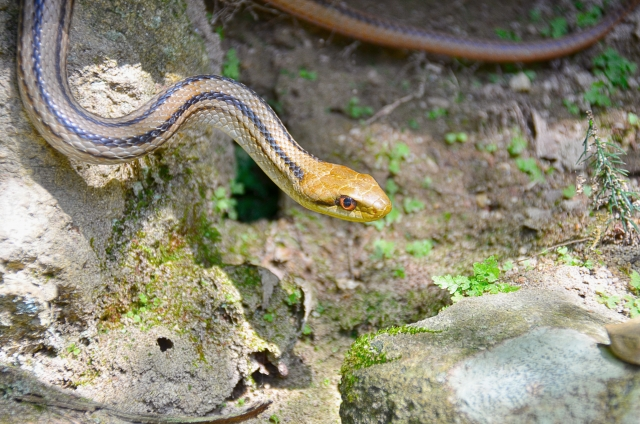
Probably the most common snake seen in Kumano Kodo.
It has a rough temperament.
Once, while walking with a client, it jumped at me when the client poked it with a trekking pole.
As its name suggests, the striped snake has stripes on its body.
However, there are many individual differences between these snakes as well, and it can be difficult to tell them apart.
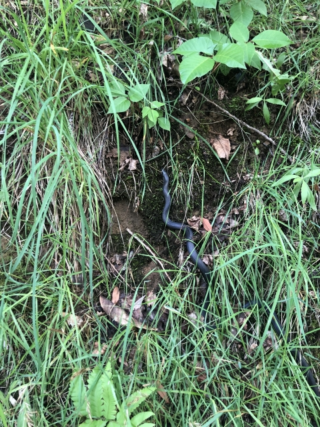
I have been bitten by this one, and it seemed to have saw-like fangs that went deep into my finger.
I bled quite a bit.
Even though it is not poisonous, it seems that it catches its prey effectively by making its fangs in such a shape.

Ratsnake

They look much like Four-lined Ratsnake, but they are larger than thme, with some reaching up to 2 meters in length.
When I went mountain stream fishing deep in the mountains, I once encountered a huge one whose body was more than 5 cm in diameter. It was too big to see the whole thing, but since there are no giant snakes in Japan, I think it was probably a giant version of this one.

The aodaiso also has stripes, but they are more indistinct than those of the striped snake, and the body color is greenish.

The decisive difference is the color of their eyes.
Four-striped Ratsnake’s are reddish, while Ratsnake’s are olive (brown).
However, this feature can only be seen up close, so I don’t think it is a good way to tell them apart.

Burrowing Ratsnake
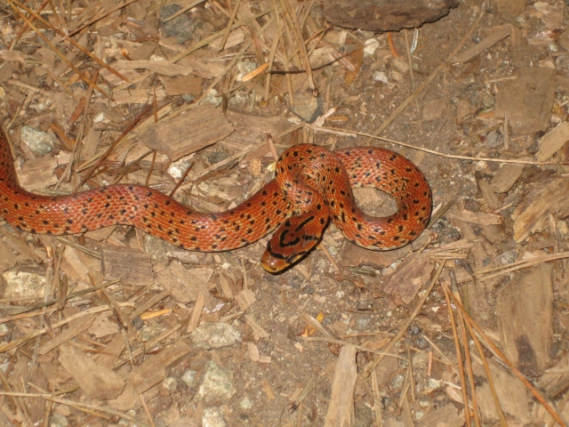
Although it may look like a showy, venomous snake, this one is not poisonous.
In its juvenile stage, the snake is bright reddish in color, but as it grows, the reddish color fades and becomes brownish.
However, there are individual differences among these snakes as well, and some are difficult to judge in general.

As they are called “burrowing ratsnakes,” they seem to like burrows and are good at digging.

I have seen this one several times in Kogumotorigoe.
One time, a guest found one with its head in a gap between two rocks, and there was a small commotion.

The guest said confidently, “That’s definitely a venomous snake, isn’t it?”
I was once given a dubious look when I replied, “No, it’s not”.

My first “encounter” with this snake was when I was walking in the Hatenashi Mountains, and I almost stepped on one.
At that time, it was wagging its tail and making noises in a threatening manner, just like a rattlesnake, so I thought, “Oh my God, does this one have poison? ”
Anyway, I calmed it down and had it go away.
When I got home, I checked it out and found that it was not poisonous…

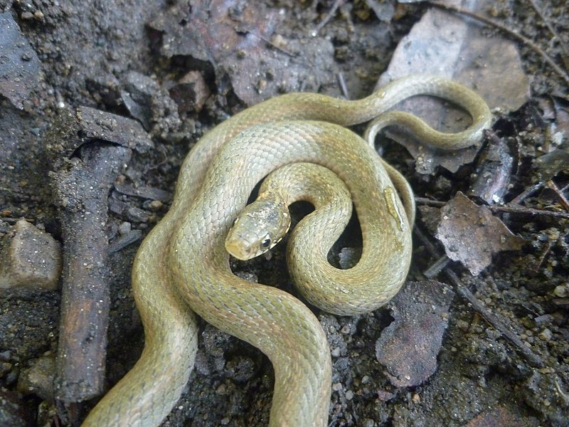
Japanese Keelback
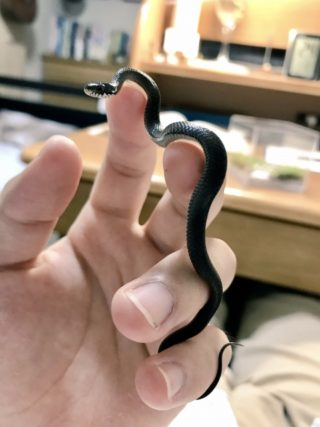
I saw this one while walking along the Kumano Kodo Kohechi trail, so I am adding it to the list.
The individual in the photo is quite small, but even if it grows up to about 60 cm at most, it is a small snake.

The one we saw was about 40 cm.

We could not get a good look at it because it was running away so fast, but the mountain guide said so, so I am sure of it.

We saw two of them while we were walking.

The Japanese name “hibakari” comes from the phrase “if you are bitten, you live only a day,” and they used to be thought of as poisonous snakes.

If you see a snake

If you see a snake, the only thing you can do is “just stay away from it and don’t stimulate it.
Snakes bite as a last defense measure, and they are not like some humans who like to fight with each other.

If you remain a little calm, the snakes will leave you.

Also, you need to be careful not to go into the bushes, and to watch your step so that you do not accidentally step on a snake.

That is all for now.
I hope this will be of some help to you.
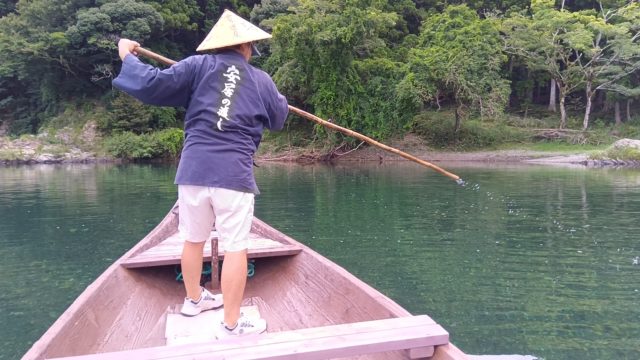
安居の渡し

安居の渡しとは、大辺路沿いにある日置川を渡す舟のことです。

一旦は途絶えていましたが、2005年に約50年ぶりに復活して活動をされていました。

しかし、その後再び途絶えましたが、2024年2月3日に土日祝限定で再開することになりました。

私は2014年に2回ほど利用をしたことがあります。

船外機ではなく手漕ぎの舟なので、往時の旅人の気分を味わうことができることが魅力です。

今回はそのあと仏坂を歩くことにしていました。

一人歩きの場合や、車が一台しかない場合、交通の便がネックですね。

今回私は紀伊日置駅に車を置き、コミュニティバスに乗って安居まで行き、周参見駅まで歩いてから電車に乗って日置駅まで戻ってきました。

白浜町のコミュニティバスは、便によっては予約は必要です。

安居の渡しを体験してから仏坂を歩くのであれば、予約が必要です。
しかし、日祝、年末年始は運行していません。

・・・ということは、白浜町のコミュニティバスを利用し、安居の渡しを楽しむためには、土曜しかチャンスがないということになります。

私は9:29紀伊日置駅発の便を利用しました。
安居までは約15分です。
白浜コミュニティバス三舞線 時刻表

渡し舟の予約は、080-2500-3223 に、住所、氏名、連絡先、運航希望日、時間、人数を記入してショートメッセージを送ります。

なので、今多くの語り部団体さんなどがやっている、申込み用紙をダウンロードして、それに必要事項を手書きをしてファックスで送信するという手間は省けますので、楽といえば楽です。

安居も渡しについてはこちら
2024年2月3日(土)「安居の渡し」再開!

バスを降りて安居の渡し場で待っていると、前職でお世話になった方が来てくれました。

世間は狭い。

ライフジャケットを着て、準備ができればいよいよ渡しです。

直線で渡してもらえば、ものの3分くらいで対岸に到着しますが、少し上流まで上ってから渡してくれましたので、清流・日置川の魅力も十分に楽しめました。

対岸についてから少し船頭さん(2人来てくれます)とお話をしましたが、会の保存もなかなか大変なようで、詳しく書くことは控えますが、「やめるか、値上げか」という話も出ているそうです。

また、人手の問題もあり、現在は7人(実質6人とおっしゃっていました)で運営をされているそうで、今回も、もう一人の方はお店を閉めて来てくれたとのことです。

せっかく復活した安居の渡し、なんとか存続してもらいたいものです。

雲雀山~糸我峠~湯浅・広村

最近は紀伊路にハマっていて、どこか歩くとなれば紀伊路を歩いています。

今回は、紀伊宮原駅~湯浅駅までを歩いてきました。

旅行業を立ち上げるために、HP用の写真を色々と準備しています。
今回の目的も、それがメインでした。

これまで、糸我峠は4回歩いたことがあるのですが、全部曇りか雨で、晴れた日の写真がなかったのでどうしても晴れた日の糸我峠の写真を撮りたくてこの日を選びました。

9月とはいえ、この日は湿気が多く相当暑かったです。

日本最古と言われる糸我稲荷神社を過ぎると、ほどなく雲雀山の入口があります。

看板を見ると、どうやら糸我峠につながっているようです。
以前から気になっていたこともあったので、今回は行ってみることにしました。

最初は梅とみかんの畑の中を通りますが、その後は非常にいい道で景色も良く、気持ちよく歩くことができました。

ただ、急坂の部分があるので、やや健脚向きかもしれません。

道中もいい眺めのところがあるのですが、特に山頂からの眺望がすばらしかったです。

山頂からはほどなくコンクリートの道(農道)になりますが、尾根伝いにあるく感じなのでアップダウンもあまりなく、また、木陰の中を歩くので非常に快適でした。

糸我峠で、湯浅町観光協会の方が紀伊路のPR動画の撮影をしていました。

湯浅ではかどや食堂で生しらす丼を食べ、広川町の濱口梧陵記念館と、梧陵さんがつくった広村堤防に行ってきました。

濱口梧陵さんといえば、稲村の火が有名ですが、梧陵さんの功績はむしろその後に取り組んだ復興の方を評価されています。

村人が広村を離れないように、私財を投げうって堤防を築く工事を開始し、村人を雇って賃金を払い、橋を架け、寄付金を工面・・・

村が復興したのを見届けてからは、より多くの見聞を広めるためにアメリカに渡り、その生涯を閉じます。

梧陵さんの生き様は、心を打たれるものがあります。

私の憧れの人です。

過去の紀伊路の記事は、こちらをご参照ください。
【紀伊路】紀伊宮原駅~湯浅駅①

Kumano Kodo (1), a day trip from Osaka 

Many people may say, “I don’t want to walk too strenuously, but I want to enjoy the atmosphere of the Kumano Kodo”.

Some people may think that Kumano, in particular, is “quite difficult even to reach” due to accessibility issues.

In this issue, I would like to introduce “recommended Kumano Kodo” that can be reached in a day trip from Osaka.

Fujishirozaka

This time, let me introduce you to Fujishirozaka on the Kumano Kodo Route.

Fujishirozaka is located on the Kiiji route and can be reached by train from Osaka in about an hour.

Although the Kiiji route has not yet been registered as a World Heritage site, there are already several places that have been registered as national historic sites.
Considering the order in which they are registered as World Heritage sites, additional sites may be added to the list in the future.

On this route, the Fujishiro Shrine and the Suzuki residence are such sites.

The first half of the route has many interesting sights such as the remains of the Suzuki residence, the Fujishiro Shrine, the tomb of Crown Prince Arima, and the bamboo grove on Fujishirozaka, while the second half of the route changes dramatically and takes you through tangerine fields.

The Garden of Suzuki residence
Fujishirozaka
Tangerine fields

If you make it all the way up Fujishiro-zaka, a “reward” will be waiting for you.

Although slightly off the course, Fukusho-ji Temple is also recommended.
Fukusho-ji Temple is a Shingon Buddhist temple, which is rare in this area, and is said to be the place where Kukai crossed the Fujishirozaka slope and practiced asceticism just before going to Tang China.

In addition, under the devotion of Yorinobu Tokugawa, the first lord of the Kishu domain, Gumonjido was built.

Gumonjido is a hall where the Shingon esoteric Buddhism practice called Kokuzo Gumonji Dharma is performed.
Both the main hall and the Gumonjido are nationally important cultural properties.

On the premises of the temple is the “Urami no Taki Waterfall,” which is said to have been named by Lord Yorinobu.
As the name suggests, the waterfall can be seen from the back (however, there are times when there is no water. Whether you can see the waterfall or not depends on your luck!).

As you will see when you go there, it is a place with a unique and relaxing atmosphere.

Fujishirozaka may be a little tough, but it is packed with sights, scenery, and more than enough to give you a taste of the atmosphere of the Kumano Kodo.

Please come and visit once.

Access

Departure: Kainan Station

End: Fukusho-ji Temple (or Kutsumoto-dobashi)

Distance: approx. 5 km

Approximate time required: 3-4 hours

From Fukusho-ji Temple, take a taxi to Kainan Station or Kamogo Station.
For taxies, call Ariko Wakayama 073-471-3333.
Taxis are available without reservations on the day of the ride.
If there is a vehicle waiting at Kamogo Station, it will take about 10 minutes. If the vehicle is out of service, it will pick you up from Kainan Station in 20 minutes.
It is possible to walk to Kamogo Station, but it takes about 1 hour.

Guide Requests

It is a waste to just walk!
Walking with a guide will make your walk even more enjoyable.

Please contact the Wakayama Local Guide Association for a guide for an English-speaking guide.

大阪から日帰りの熊野古道① 

「あまりガッツリは歩きたくないけど、熊野古道の雰囲気を楽しみたい」という方は多いのではないでしょうか?

特に熊野はアクセスの問題で「到達するまでも結構大変」と思われている方もいらっしゃると思います。

今回は「大阪から日帰りで行けるオススメの熊野古道」をご紹介いたします。

藤白坂

今回は熊野古道藤白坂です。

藤白坂は紀伊路ルートにあり、大阪からでも電車で1時間ほどで来ることができます。

紀伊路はまだ世界遺産に登録されてはいませんが、すでに何ヵ所か国の史跡に登録されているところがあります。
世界遺産登録への順序を考えると、将来追加登録がされるかもしれません。

このルート上では藤白神社・鈴木屋敷がそれにあたります。

前半は鈴木屋敷跡、藤白神社、有間皇子の墓、藤白坂の竹林など見どころが多く、後半は様相が一変し、ミカンの畑の中を歩きます。

鈴木屋敷
藤白坂

藤白坂を上り切れば「ご褒美」が待っていますよ。

少しコースからは外れますが、福勝寺もお勧めです。
福勝寺はこの辺りでは珍しい真言宗のお寺で、空海が唐に渡る直前藤白坂を越えてきて修行をされた場所と伝えられています。

また、初代紀州藩主・徳川頼信公の帰依により、求聞持堂(ぐもんじどう)を建立します。

本堂・求聞持堂ともの国の重要文化財です。

境内には頼信公が命名したとされる「裏見の滝」があります。
読んで字のごとく、裏から滝を見ることができます(ただし、水がない時もあります)

行ってもらえればわかりますが、独特の雰囲気があり落ち着く場所です。

藤白坂は少しキツいかもしれませんが、見どころ満載で景色もよく、熊野古道の雰囲気を味わうには十分すぎるものがたくさん詰まっています。

ぜひ一度お越しください。

アクセス

出発:海南駅

終了:福勝寺(または橘本土橋・きつもとどばし)

距離:約5km

所要時間の目安:約3~4時間

福勝寺からはタクシーで海南駅、または加茂郷駅(かもごうえき)まで。
タクシーは有交和歌山 073-471-3333
当日予約なしでも利用可能です。
加茂郷駅に待機している車両があれば約10分、もし出払っている場合は海南駅から20分で迎えに来てくれます。
加茂郷駅まで歩くことも可能ですが、約1時間かかります。

コースマップはこちら
海南駅~紀伊宮原駅
※地図上にある紀伊宮原駅まで一気に歩けなくはないですが、健脚向けです。

こちらをご参考にされてください。
紀伊路・藤白坂~拝の峠

 ガイドのご用命

ただ歩くだけではもったいない!
ガイドと歩けば、さらに楽しいウォーキングになりますよ。

ガイドのご用命は紀伊路語り部の会様、外国語のご用命は和歌山地域通訳案内士会まで。

紀伊路語り部の会
和歌山地域通訳案内士会 

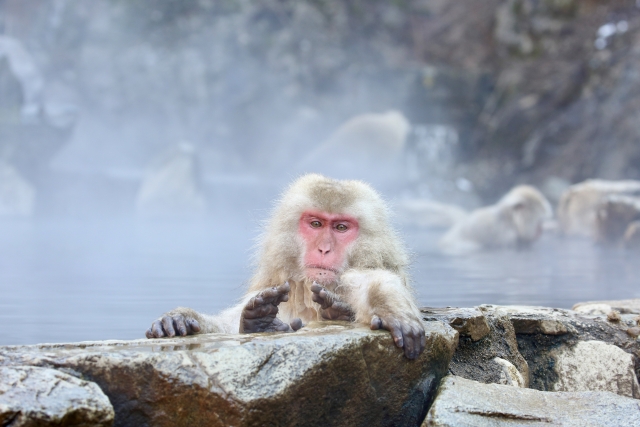
鳥獣被害と動物について①

熊野古道でも身近に見られる動物についてお伝えします。
今回はサルについてです。

サルの特徴

食べ物

  • 雑食性
  • 短時間に大量に食べられるものが好き
  • トウガラシ、シシトウ、ゴボウなどは食べないとされている

身体能力

  • 立体的な動きが得意
  • 垂直飛びは約2m
  • 水平飛びは約2m(高いところから跳躍できるので、着地点が大幅に伸びることがある)

繁殖

  • 農作物を食べて栄養状態が良くなると繁殖力が向上、死亡率も低下する
  • 2~3年に1回、1頭出産
  • 初産は7~8歳
  • 赤ん坊の死亡率は30~50%

生活

  • 群れ 10~100頭程度で、一定の行動域(個体が増えると分裂する)
  • メス 生まれた群れで一生を過ごす。群れのまとまりの要
  • オス 4~5歳で生まれた群れを出る

【熊野古道紀伊路】紀伊内原駅~西御坊駅⑧

【紀伊路】紀伊宮原駅~西御坊駅①
【熊野古道紀伊路】紀伊宮原駅~西御坊駅②
【熊野古道紀伊路】紀伊宮原駅~西御坊駅③
熊野古道紀伊路】紀伊宮原駅~西御坊駅④
【熊野古道紀伊路】紀伊内原駅~西御坊駅⑤
【熊野古道紀伊路】紀伊内原駅~西御坊駅⑥

【熊野古道紀伊路】紀伊内原駅~西御坊駅⑦

岩内王子

岩内王子跡は、岩内コミュニティ館の敷地内にひっそりと佇んでいます。

正面 無格社 焼芝王子神社旧跡

裏面 明治四十一年十月二十二日
   村社熊野神社ニ合祀ス

焼芝王子(岩内王子)は、もともと日高川を渡った近く(字 王子周辺)に鎮座していたと考えられています。岩内の地は、日高川を挟んで西の小松原宿とともに重要な位置を占めていました。
王子は元和元年(1615年)の大洪水で滅没し、字 田端(現在地より南方)に移動、明治時代に熊野神社に合祀されました。

舞妃蓮

天皇・皇后両陛下ゆかりの蓮

アメリカ黃花蓮明仁殿下(当時)1960(昭和35)年、ご成婚間もない継宮明仁殿下がご訪米された際、日系アメリカ人の小川一郎氏がミシシッピー川中流域で採集されたアメリカ黃花蓮の果実を殿下に献上した。
殿下は帰国後、その果実を蓮の第一人者である大賀一郎氏に託したのである。
翌年、博士は、その発芽育成に取りかかり、1962(昭和37)年にできた蓮根を教え子の阪本祐二氏に(1925-1979 当時日高高等学校教諭)に分根。
黃花蓮は殿下に因み、大賀博士により「王子蓮」と名付けられた。

「舞妃蓮」の誕生

阪本氏は思い描いていた色調豊かな蓮を作り出すべく、1966(昭和41)年、王子蓮と大賀蓮の交雑を試みた。
試行錯誤の末、交雑は成功し、1968(昭和43)年6月21日三つの鉢のうち、第1の鉢で最初の花が開いたのである。
阪本氏はその様子を「黄色地にほのかに大賀蓮の紅がかかり、色調は穏やかな今までにない色をなして咲いた。しかも両親より花径は大きく、35cmにもなる大輪種で豊かなものであった」と雑誌「京都園芸」に記している。

この年、阪本氏は、王子蓮との所縁から東宮御所に献上すべく、第3鉢を運送業者に依頼し東宮御所まで運んだ。
果たして蓮は6月28日に東宮御所で開花し、両殿下と礼宮様にご覧いただいたのである。また、2輪目の開花時には昭和天皇・香淳皇后にもご覧頂いている。

色合いの特徴のほか、これまでの蓮になかった2日目の花が閉じる際の捻れの様子から「舞うがごとき」特徴を目につけた阪本氏は、美智子妃殿下(当時)の優美なお姿を重ねて「舞妃蓮」と名付けた。

「舞妃蓮」が皇居に1996(平成8)年、明仁天皇陛下「舞妃蓮を皇居に導入したい」との依頼が阪本家にあり、翌年春に分根。
1999(平成11)年には皇居花陰亭で開花したとの報告が阪本家に届いている。

その後皇居で大切に育てられ、2010(平成22)年に出版された「御所のお庭」(扶桑社)には「皇后陛下に捧げられた女神の花」として掲載された。

御坊生まれの舞妃蓮「中山の蓮池」

御坊生まれの蓮ながらこれまで定植されなかったことから2008(平成20)年、阪本家からここ「中山の蓮池」に移植され、「御坊生まれの舞妃蓮」として新たに出発したのである。

舞妃蓮誕生までの経緯が詳しく書かれています。
大賀蓮は、上記文中でも登場する蓮の権威・大賀一郎氏によって発見された蓮で「2000年蓮」とも呼ばれています。
現在は日本各地に分根され、紀南地方では上富田町岡の田中神社、白浜町富田、熊野古道沿いの発心門地域などで見ることができます。
大賀蓮発見の経緯についはこちらをご覧ください。
大賀ハス

西御坊駅

日本一短いローカル私鉄・紀州鉄道の最終駅。ここから御坊駅までは2.7km。
駅も西御坊→市役所前→紀伊御坊→学門→御坊でおしまい。
しかし、独特の揺れがなんとも心地良いです。

堀河屋野村

建物がすでにいい味を醸し出しています

紀州鉄道西御坊駅の近くには、醤油の老舗・堀河屋野村があります。
私達が訪れた時は閉店していましたので中を見ることはできませんでしたが、本物の醤油を昔ながらの伝統を守りながらつくっています。

以前、外国のお客様が醤油を作っているところを見たいと言われ、こちらを紹介したところ大変気に入ってくれたとのことでした(私がガイドに行ったわけではありませんので)

一度足を伸ばしてみても面白いと思います。

堀河屋野村

【熊野古道紀伊路】紀伊内原駅~西御坊駅⑥

過去の記事はこちら
【紀伊路】紀伊宮原駅~西御坊駅①
【熊野古道紀伊路】紀伊宮原駅~西御坊駅②
【熊野古道紀伊路】紀伊宮原駅~西御坊駅③
熊野古道紀伊路】紀伊宮原駅~西御坊駅④
熊野古道紀伊路】紀伊内原駅~西御坊駅⑤

湯川子安神社

所在地 御坊市湯川町小松原89番地

祭神 木花咲耶姫命由緒安産の神、子授けの神、母性保護の神、育児の神

沿革 
湯川氏が当地を支配していたとき、邸の一隅に明神社を祀っていたが、天正年間に静岡県大宮に鎮座の元官幣大社浅間神社より、その分霊を亀山城内の明神社と共に勧請し城主湯川直春公が息女の安産をご祈願され、無事ご安産なされました。

その後天正13年(1585年)豊臣の兵火にかかり全焼した後、現在の地に再興して子安神社と創建せされ多数の参拝の方々がご加護を賜って居ります。

明治になって再び火災で全焼し、明治15年(1883年)再興がし、昭和10年(1935年)9月本殿を修復し拝殿を新築した。

お参りの皆様方は、祭神木花咲耶姫命様に、お産が軽くありますように、また、立派な赤ちゃんが授かりますようにと、心をこめてお祈りください。

明治42年神社合祀令により13社合祀す

祭神の木花咲耶姫(コノハナサクヤヒメ)様は、記紀神話に登場する神様のお一人で、瓊々杵命(ニニギノミコト)のお妃様です。
木花咲耶姫が一夜にして瓊々杵命の子を身ごもったことから、瓊々杵命は妻を疑います。
信じてもらいたかった木花咲耶姫は、「わたしの孕んだ子がもし天神の子でなかったら、必ず焼失せよ。もし天神の子なら、損なわれることはないでしょう」と言って産屋に火を放って3人の子を無事に産みました。

このお話から、安産の神、子授けの神と言われるようになったのでしょう。

木花咲耶姫姫様のお父様は大山祇命(おおやまずみのみこと)です。
大山祇命には、磐長姫命(いわながひめのみこと))と、妹の木花咲耶姫命がいました。
大山祇命は、娘二人を瓊々杵命の元に嫁に出すのですが、容姿端麗な木花咲耶姫にくらべて、磐長姫は醜く、瓊々杵命は木花咲耶姫だけを娶り、磐長姫を大山祇命の元へ帰してしまいました。

これを知った大山祇命は大変恥じ、「磐長姫をお送りしたのは、天津神の命が常に石のように変わらず動きませんように、木花咲耶姫をお送りしたのは、木の花が咲くように栄えますようにとの願いをかけたからです。木花咲耶姫一人が残ったのであれば、天津神の命はもろくはかないものになるでしょう」といいました。

これ依頼、天皇の命が限りあるのものとなり、寿命が短くなったといいます。

さて、木花咲耶姫が産んだ3人の子は、古事記・日本書紀はもちろん、日本書紀の中でも大きく呼び名や当てられた漢字が違います。
その理由はよく分かりませんが、日本書紀一書(第二)から引用します。

火を着けて焼いて初めて炎を出た時に生まれたのが火酢芹命(ホスセリノミコト)、次に炎お盛んな時に生まれたのが火明命(ホアカリノミコト)、次に生まれた子が彦火火出見命(ヒコホホデミノミコト)でした。

この3番目に生まれた彦火火出見命の子孫が鵜草葺不合命(ウガヤフキアエズノミコト)で、そのご子息が神日本磐余彦尊(カムヤマトイワレヒコノミコト)またの名を神武天皇と言います。

和歌山県内で木花咲耶姫様をお祀りしている神社は?

和歌山県内で、木花咲耶姫様を主祭神として祀られているお社は結構少ないです。

串本町田原の木葉神社が有名ですが、あとは那智勝浦町内の椙吉神社、そしてこの湯川神社くらいでしょうか。

配祭神も含めて祀られているお社はこちらをご参考にされてください。
木花咲耶姫様が祀られている神社(和歌山県内)

上記は、和歌山県神社庁に登録されているお社なので、地元の小さいお社などを含めるともっと多いかもしれません。
「子安神社」と呼ばれているお社は、まず、木花咲耶姫をお祀りしていると思ってもいいと思います。
ちなみに、あまり知られていないかもしれませんが、伊勢の内宮の境内にも「子安神社」がありますよ。こちらは、お父様の大山祇命が祀られているお社もあります。
大山祇神社・子安神社

山の神の話

浅間神社は有名なのでご存知の方も多いでしょうが、もちろんこちらの御祭神は、木花咲耶姫様です。
木花咲耶姫は富士山の神とも言われています。
また、よく熊野古道でも話題に挙がる「山の神」の話ですが、この神様も木花咲耶姫様だそうです。

山仕事に行く人達は、入り口にある小さな祠にやお社にお参りしてから入るところもあるようです。

「山の神は女性の神様なので、女性が祭りや祭りの準備に参加してはならない」
「お供え物は美しい女性を連想させる鯛などではなく、見た目の醜いオコゼを供える」
「祭りやその準備などはすべては男が執り行った」

という話を聞いたことがあると思います。
しかし、これは後付けの作り話でしょうね。

これは私見ですが、祭りを汚さないことと、女性を大切にしていたからではないかと思っています。

男女の性の乱れは今に始まったことではありません。

あの空海も、高野山を女人禁制にしたのは、女性がいると湧き上がる性欲に負けて修行の妨げになるからだったと聞いたことがあります。

上皇・法皇も、熊野に参る前には約1週間の精進潔斎をしますが、この期間中は性交も断ちます。

祭りは神事であり、神聖なものですので、そこに女性が入ると良からぬことを考えて場(あるいは気)が汚れると考えた末に生まれたものではないかと思います。

赤ちゃんを産み、育てることができるのは女性だけです。
山仕事は肉体的な危険が伴いますので、そういったところへ入って万一事故でも起これば子孫を産む人が減るわけで、村の存続にも関わってくることだったと思います。
なので、女性を大切に思い、危険な山に入れないように戒めたのが女人禁制だったのかもしれません。

昔から、日本は女性にも、子供にも平等に大切にされてきました。
和泉式部や紫式部、清少納言が文学作品を書いたのは今から1000年前です。
こんな時代に、女性が文学作品を書いた例などというのは、海外ではありません。
また、ある外国人が来た時には、「子供も非常に大切に扱われている」と驚き、日記か何かに書いています。
子供の人身売買が日常だった外国に比べれば、日本の女性は子供は、格段に平等に扱われていたのです。
もちろん、日本にも人身売買がまったくなかったわけではないようですが。

ここからは信じる人だけでかまいません。
そんな木花咲耶姫様ですが、あるお方を通してメッセージを降ろされています。
こちらにその「神示」を掲載しています。
世の中のことを的確に指摘され、これから人はどう生きていくべきなのかということを伝えています。
興味のある方でかまいませんよ。
木花咲耶姫様の御神示 -令和編-

【熊野古道紀伊路】紀伊内原駅~西御坊駅⑦に続きます。

【熊野古道紀伊路】紀伊内原駅~西御坊駅⑤

過去の記事はこちら
【紀伊路】紀伊宮原駅~西御坊駅①
【熊野古道紀伊路】紀伊宮原駅~西御坊駅②
【熊野古道紀伊路】紀伊宮原駅~西御坊駅③
熊野古道紀伊路】紀伊宮原駅~西御坊駅④

道成寺までの道中、コース沿いに川が流れていますが、この川にはカメがたくさん泳いでいました。おそらくほとんどすべてがミシシッピアカミミガメです。
ミシシッピアカミミガメは昔の夜店などで「ミドリガメ」として売られていました。
このカメが大きくなると、飼いきれなくなった人が放したことがきっかけで爆発的に増えてしまいました。
今は日本全国に分布が広がっています。
これによって在来種のイシガメの生息域が追いやられ、その数が激減しています。

カメの外来種ではクサガメがいます。
以前は日本でも自然に分布していると考えられていましたが、どうやら人為的に離された可能性が高いということのようです。
「クサガメ」という名前の由来は、本当に臭いからです(笑)

外来種の放流は在来種を駆逐してしまうことがよくあります。

この川も「異常事態」でした。

ちなみに、外国から持ち込まれた種を「外来種」と言いますが、その土地に元来いない種が国内から持ち込まれた例もあります。

これを「国内由来の外来種」、略して「国内外来種」と呼んだりします。
たとえば、北海道にはもともとカブトムシはいませんでしたが、誰かが離したことによって繁殖しています。

外来種が入ることによって懸念されるのは、在来種の駆逐(捕食)、ハイブリッド(混血)、競合などです。

熊野古道沿いでよく見る棕櫚(しゅろ)の木も、在来種と外来種がありその交雑種があるといいます(なかなか見分けが難しいですが)

子供の頃にはセイタカアワダチソウが最盛期を迎え、周りのススキを駆逐し始めました。
これは先出の「競合」にあたります。
しかし、最近はセイタカアワダチソウの勢いが衰え、在来種のススキが勢いを盛り返しています。

外来種については、またの機会に。

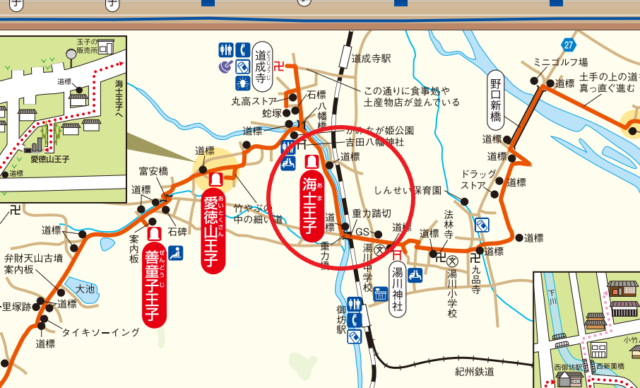
海士王子

熊野九十九王子の一つでくわま・クハマ・クリマなどと呼ばれ小松原宿所を控えた要所で御幸記建仁元年以後由緒ある王子社であった。

「九海士の里」のいわれ

神功皇后、三韓征伐の凱旋のときに日高の港で産気を催され、めでたく安産されたのが十五代応神天皇です。

その時、産湯に使われたのが「産湯」、胞衣(えな)を埋めたところが「衣奈(えな)」といって今も地名に残っています。

産後の肥立ちもよく、都へご帰還されるときに「地を開き、民を愛せよ」と九人の兵士を残し、この土地を与えられました。

九人の兵士は漁を業としたのでいつしか「九海士の里」というようになりました。

神功皇后が三韓征伐の時にどんなルートを通ったのかは私は分かりませんが、朝鮮に向かって目的を達成されたあと、凱旋で日本各地を回ったということなんでしょうかね。

産湯は日高町、衣奈は由良町にあります。

【熊野古道紀伊路】紀伊内原駅~西御坊駅⑥に続きます。

【熊野古道紀伊路】紀伊宮原駅~西御坊駅④

過去の記事はこちら
【紀伊路】紀伊宮原駅~西御坊駅①
【熊野古道紀伊路】紀伊宮原駅~西御坊駅②
【熊野古道紀伊路】紀伊宮原駅~西御坊駅③

髪長姫と道成寺

吉田八幡神社の下に、髪長姫の物語を書いた看板がありました。

7世紀後半、九海士の里で誕生した宮子には大きくなっても髪が生えませんでした。

ある年、九海士の里は不漁。不漁の原因は海底から射す不思議な光でした。

宮子の母・渚は「娘に髪が生えないのは前世の報い。私が罪滅ぼしをすれば・・・」と自ら犠牲となって里人を救おうと海に飛び込みました。
海中に深く潜り、光り輝いているものを確かめると、それは小さな黄金の観音様でした。

渚は海中から観音様を拾い上げると庵に大切に祀りました。

光が消えた海では大漁続きとなりました。里人たちは渚を限りなく尊敬しましたが、渚は手柄を誇ることもなく謙虚に里人のため礼拝を続けました。

ある夜、渚に観音様が現れます。夢の中で髪の生えないかわいそうな娘のことを訴えました。
夢から覚めると宮子に美しい髪が生えており、宮子の父・早鷹と渚は大変喜び、観音様のおかげと大変感謝しました。

年頃になると髪ものび、とても美しい黒髪であったので「髪長姫」と呼ばれるようになりました。

ある日宮子の美しい黒髪をツバメがくわえ、奈良の都の当時勢力を誇っていた藤原不比等の宮殿まで運びました。
不比等はその美しい髪を見て「この髪の持ち主を宮仕えに迎えよう」と養女に迎えるのでした。

藤原不比等の養女となった宮子は、文武天皇の御后となり、奈良の東大寺を建立した聖武天皇をお産みになりました。

宮子は奈良に行っても故郷の九海士の里を忘れられず、特に庵に残してきた観音様気になり悩んでいました。
その悩みはやがて天皇のお耳に達し、「宮子に長く美しい髪を与えた観音様を祀るお寺を造立せよ」との勅命により、道成寺が建立されたと言われています。

本当にツバメが髪をくわえて行ったのかかどうかは分かりませんが、神社仏閣の由緒って、どこまでが本当でどこまでが「盛られた」話なのか分からないところがまた面白いと思います。

弘法大師が唐から三鈷杵を投げたとか(笑)
3つの月が降りてきたとか。
熊野の神々が岩に降りたとか。

熊野権現垂迹縁起の記述は、個人的に嘘だと思っていますがね。

道成寺

お参りしたあと、住職さんの道成寺と安珍清姫のお話を聞きました。

道成寺の説明では真面目?にされていましたが、安珍清姫の絵解き説法は冗談を交えて非常に面白かったです。
ちょっと綾小路きみまろのように、聴衆をちょっとイジるという印象でした。

今回お話いただいた方は、英語でも説法ができるそうなので、外国人をお連れすれば喜んでくれると思います。

安珍清姫のお話は、元になったお話がありますが、そのご紹介はまたの機会に。

要約版はこちらをご参考にされてください。
安珍と清姫の物語

和歌山県の地図には、「蛇塚」と書かれていたので行ってみましたが、特に説明看板もなく、これが何なのかはよく分かりません。

【熊野古道紀伊路】紀伊内原駅~西御坊駅④に続きます。