Then, as the Japanese army was disarmed and waiting to board their ships to leave port, fire arrows were shot out of nowhere toward the Japanese army. These fire arrows were shot not only at the Japanese army, but also at the Tang army.
The Tang army thought that the Japanese army had broken its promise and shot arrows at them, and the Japanese army also thought that the Tang army had betrayed them and shot arrows at them, and from there the battle began again.
However, it was natural that they would be at a disadvantage if they were shot with fire arrows while on board their ships.
That led to the loss of 10,000 casualties.
After this great defeat of the Japanese forces, the allied forces of Tang and Silla (actually the army of Tang) pinched Goguryeo and finally destroyed it.
After that battle, however, Tang troops continued to be stationed in Goguryeo and Baekje.
This did not sit well with Silla, which wanted the lands of Goguryeo and Baekje.
So, the king of Silla sent an envoy to the king of Tang and said, “We are truly grateful for the unification and peace of the Korean peninsula thanks to the Emperor of Tang. Nothing is more gratifying than this,” he said, and went on his knees for diplomacy.
Behind his back, he harassed the Tang troops stationed in the Korean peninsula by killing, disemboweling, and stealing their property.
The Tang general stationed in Silla was naturally angry when he learned of this situation. He consulted with his home country about this state of affairs, saying, “I don’t trust Silla,” but on the contrary, the emperor did not trust him. This was because Silla’s envoys were flattering the Tang emperor. However, the emperor finally agreed and withdrew his army.
What was the first thing the Tang Dynasty did when it teamed up with Silla? The Tang Dynasty asked what Silla wanted. Silla said, “I want the land of Baekje”. The Tang Dynasty then offered to send an army from the Tang Dynasty to destroy Baekje, so that it could be claimed that the Tang Dynasty and Silla had done it together. The Tang Dynasty then sent an army to Baekje and destroyed it.
In a manner of speaking, it was assumed that the allied forces of Tang and Silla destroyed Baekje. Otherwise, if the Tang Dynasty destroyed Baekje, Tang troops who entered Silla would be caught between Japan and Koguryo. If Silla did it together, it would not mean that Japan would immediately send its army into Silla, since Japan and Silla are allies in one way or another. As long as Tang and Silla were attacking Baekje, Japan could not be easily manipulated in this way.
And after Baekje was destroyed, Japan was forced to send troops.
However, when it came time to fight for three years, they realized that only the armies of Japan and Tang were fighting. Silla only ran away and did not try to fight.
So, after discussions with the Tang Dynasty, Japan decided to lower its front line and pull back its army.
After leaving the protection of Japan, Koguryo had to enhance its own military power for self-reliance and self-survival, and it thoroughly strengthened its national defense.
It trained its soldiers and built a powerful nation that would not yield no matter where it was attacked.
At that time, the Sui Dynastywas born, which attacked neighboring countries from one side to the other.
The Sui dynasty finally turned its conquests toward Goguryeo. However, Goguryeo was also strong because it had been trained as a military power. This was enough to thoroughly defeat Zui. In terms of national strength, Goguryeo and Sui were completely different, but no matter how many times they challenged each other or how many large armies they sent, Goguryeo was victorious.
Due to these repeated battles, Sui’s national power became exhausted, and finally Sui collapsed.
The Tang Dynasty arose afterwards.
The Tang naturally studied the reason why Sui was destroyed. And they found out that the cause was Goguryeo. Therefore, the Tang Dynasty decided to use the “specialty” of “distant contact and close attack”.
The strategy of “distant contact and close attack” was to establish friendly relations with distant countries and to attack nearby countries.
Geographically viewed from the Tang Dynasty, the countries beyond Goguryeo were Baekje and Silla. Baekje could not be meddled with because it was on good terms with Japan. Therefore, they decided to join hands with Silla, which had not had very friendly relations with Japan before.
After Koguryo withdrew its troops, the chief of Nonna reported the incident to Emperor Yuryaku. Emperor Yuryaku is an outstanding emperor, so when he saw the report, he immediately knew what was going on.
“This is not right.”
Since the king of Silla had escaped, the “bad guys” were not a group of thieves such as robbers.
Furthermore, tribute from Goguryeo had ceased.
I thought, “Perhaps this story is not true,” and ordered further investigation.
Upon further investigation, he found that the tribute delegation from Koguryo was attacked by Silla, which angered Koguryo and attacked Silla, but the Japanese government of Rinna sheltered the fleeing Silla king.
Hearing this, Emperor Yuryaku became angry and sent soldiers to Silla. The king of Silla replied, “I have no intention of fighting with the Japanese. I will never do anything wrong again, so please help me.”
If the king of a country apologizes to them, they cannot afford not to forgive him.
The Japanese army returned home, saying, “Do not anything bad again.”
The problem was Koguryo.
Koguryo said, “We can no longer pay tribute to Japan. Koguryo had improved its culture by getting along with Japan. However, the tributary envoys were too dangerous, and if they were to pass through Silla’s territory, they might be attacked at any time.”
What kind of psychology would Japan have upon hearing this? It can’t be helped,” he said. “Then, cheer up and do it,” right? This was the beginning of Koguryo’s departure from Japan’s protection.
Japan, which became a great empire during the reign of Emperor Nintoku, was still a very strong nation during the reign of Emperor Yuryaku. Before that, there was Empress Jingu’s conquest of the Three Hans, in which she defeated the king of Silla.
At that time, Japan was so strong that Baekje and Goguryeo (around today’s North Korea) joined together and promised to pay tribute to Japan.
In other words, the three countries of the Korean peninsula became tributaries to Japan.
However, the Silla Kingdom was a country that did not keep its promises. They did not pay tribute and occasionally skipped out. It would have been fine if they only did not pay tribute, but they began to attack Goguryeo’s envoys. This was because when Goguryeo came to Japan to pay tribute, they had to pass through Silla to get there.
The attacked Goguryeo was furious. They were angry because they were robbed of all the treasures they had.
Furthermore, the groups that paid tribute were not only men but also women. All of them were raped or killed.
Therefore, Goguryeo raised an army and attacked Silla.
The king of Silla, who was attacked, told the then “Mimana Nihonfu,” a branch office of the Japanese government, “We are being chased by bad guys. Please help us”.
When They looked over, they saw that the army was indeed closing in on him. Aside from the truth, there was no reason not to help him if he asked them to help him, so they hid him.
Goguryeo did not intend to fight Japan at all. They only attacked because Silla had done something wrong.
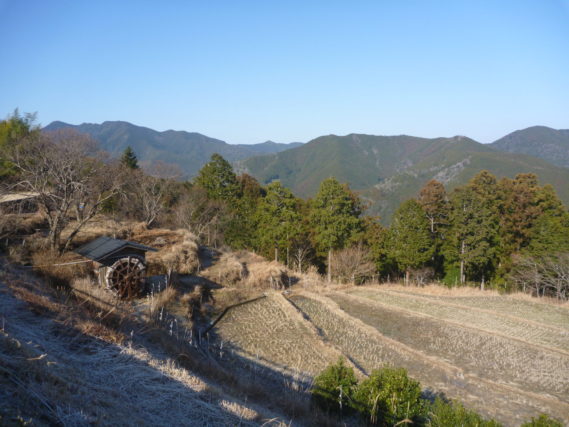
Around Aragijima, we asked a local resident to tell us about the rice terraces.
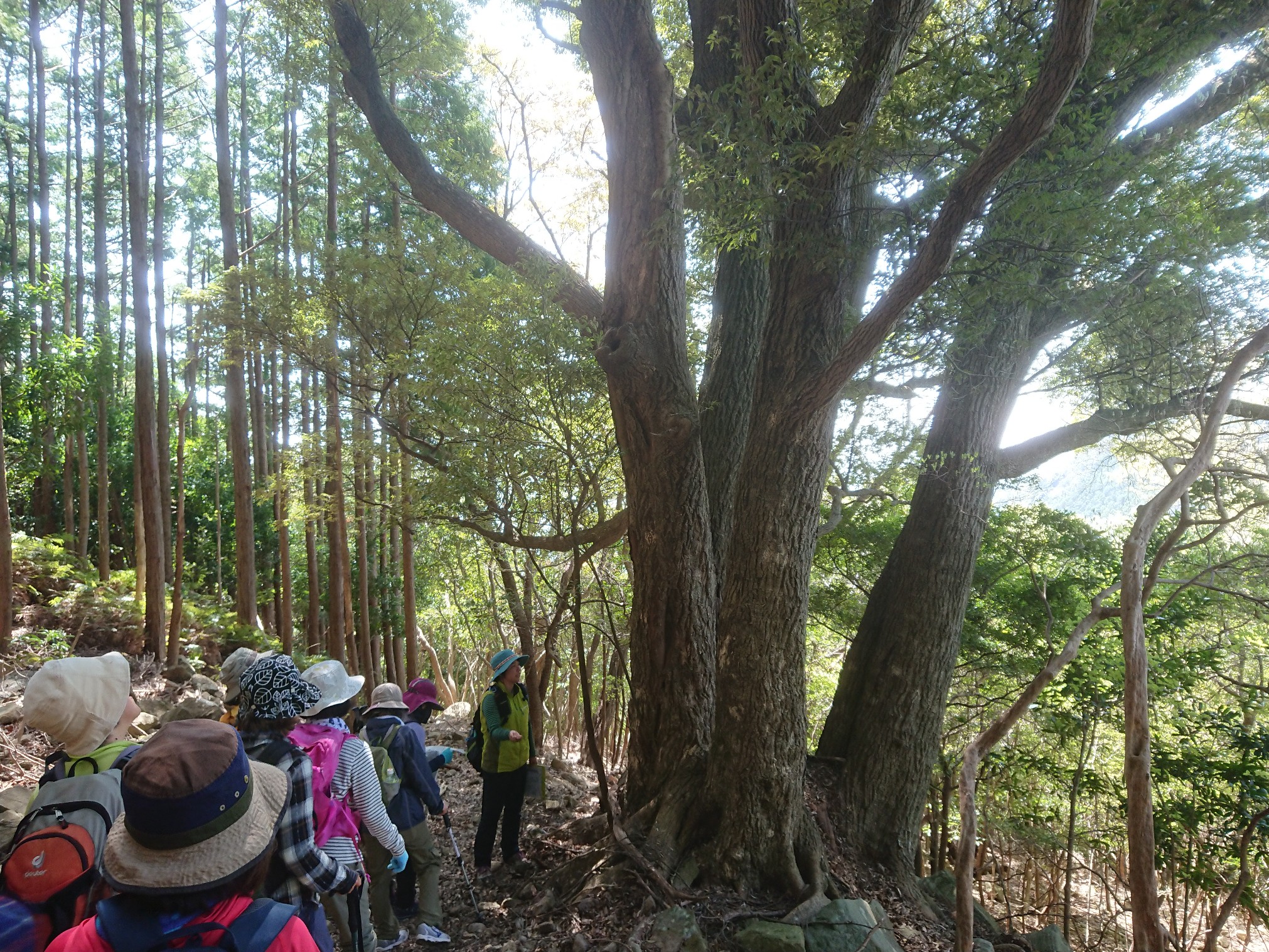
In conclusion, I am glad I asked. The stories with jokes were very interesting and funny. I also learned a lot about the use of the hemp palms that grow along the way, which I did not know about. This is something I can use next time I have a guide.
There was also an explanation of a picture book about the history of papermaking of YASUDA GAMI, and he talked about the history of YASUDA GAMI in a very easy-to-understand way.
For the papermaking experience, we experienced papermaking and making paper lanterns.
In the paper lantern making experience, it was difficult for me to make the frame, and I had a hard time tying the string and fixing it in place.
As for the finished product… I am afraid I cannot show you the finished product because I don’t want people to imitate my tasteful design (laugh).
The paper made will be mailed to me at a later date.
We also went to various other places and spent the whole day playing in the Shimizu area. The cherry blossoms were in full bloom, which was heartwarming.
At the beginning of the Heian period (794-1185), there was a book titled “Shin-sen-shoji-roku” (“Newly Selected Surname Records”). In this book, which shows the origin of names and their branches, it is noted that of the 1,200 powerful families living in the Kinki region, approximately 400 were immigrants.
Even though about one-third of the population was foreign, they were able to build a peaceful, stable, and wonderful culture.
This means that the Japanese people had clear ideals, a clear cultural awareness, and a clear vision of what Japan was supposed to be through clear education.
Because Japanese people shared these ideals, they were not at all afraid of foreigners. In fact, immigrants were all willing to “become Japanese people together”.
Today, some people say that the increase in the number of foreigners living in Japan is destroying Japanese culture, but it is more important for Japanese people to have pride, awareness, and ideals as Japanese people. If we keep criticizing them, Japan will not improve even after 100 years.
In the case of the Battle of Hakusukinoe, we still need to go back and look at history.
During the reign of Emperor Nintoku, Japan became the largest empire in East Asia and a very powerful country. What happened at that time was that among the three kingdoms of Wei, Wu, and Shu, Wu was the most powerful as a nation, Wei was strong in military power, and Shu was strong in political power. Among them, the most powerful nation was Wu, and to our surprise, Wu came to Japan to pay tribute.
The country of Wu came to Japan to pay tribute, which means that it was under the king of Japan.
The fact that the nation of Wu in the “Romance of the Three Kingdoms” came to Japan to pay tribute shows how powerful Japan was.