Previously, we discussed how Wake-no Kiyomaro fought against Dokyo and prevented him from ascending to the Emperor’s throne. In this issue, we will discuss how Wake-no Kiyomaro was able to have such a strong will.
There are many people in Japan who are called heroes, great men and women.
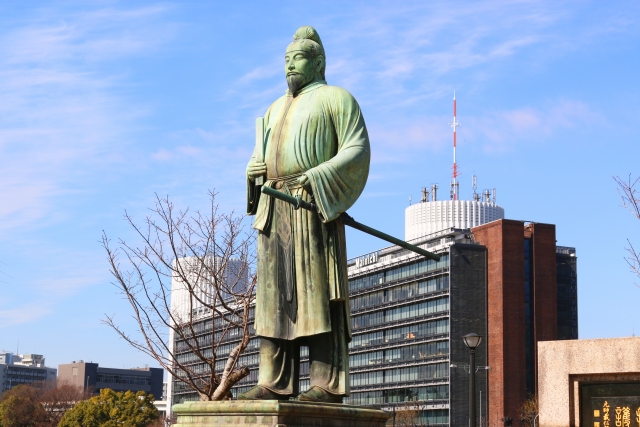
Among them, only two have statues standing around the Imperial Palace: one from a civilian official and one from a military commander.
The military commander is Masashige Kusunoki, and the civil official is Wake-no Kiyomaro.
Wake-no Kiyomaro was completely erased from history after the World War II. However, he was so well known to everyone before and during the war, regardless of their educational background or place of residence.
Despite the fact that he was such a famous figure, few people now know of him, even those who graduated from the University of Tokyo.
His great achievements were later recognized in Kaei 4 (1851), when Emperor Meiji’s father, Emperor Komei, bestowed upon him the rank of “Shinkai Shoichii” and the divine title of “Go’o Daimyojin” (God of the King).
The “Shinkai Shoichii” is a rank as a deity. This is the “Shoichi” rank, which is just below the rank of Amaterasu and other deities. This is the highest honor for a civil official in Japan.
There is a description of “authority” in the sentence.
The Japanese word “authority (Ken-i)” is different from the Western word “authority,” but I have no choice but to use the word “authority” because I can only find the word “authority” in English.
Please understand this in advance.
I would appreciate it if you could provide me with the best alternative word to “authority”.
The wife who was killed was the most beautiful woman. Now that beautiful woman is gone. This would cause trouble at night.
Emperor Wuzong asked his subordinates. “Is there any beautiful woman who can replace your wife? I’m having trouble at night.” He thought he was being asked “Who are the beauties?” His subordinate answered, “None other than His Majesty the Emperor’s mother.” Then Wuzong replied “Then take my mother into the empress’s residence.”
Upon hearing this, Wuzong’s mother was surprised.
In the end, his mother refused.
And what happened to this mother? You have probably guessed by now.
Wuzong even killed his own mother.
This story is by no means a story from another country. If we look at it from a broader perspective, Japan is being treated by the United States just like Wuzong’s mother. The president of the United States, who killed hundreds of thousands of civilians in the atomic bombings of Hiroshima and Nagasaki and the air raids on Tokyo, has not been brought to justice for genocide.
That is what the highest authority of a nation is.
He is not held accountable by anyone. If power and responsibility should be one and the same, but they are not held accountable, in other words, this is the “supreme irresponsible person of the nation”.
If that happens, it is obvious what will happen to the country, isn’t it?
How can we avoid inviting such a situation?
The highest authorities of a nation must be held accountable and aware of their responsibilities.
The answer is that there must be another supreme national authority above the supreme national authority.
If the nation and its people are made “great treasures” by the nation’s highest authority, then it becomes their role to serve the people, the land, and the nation.
This will change the way those in power think.
This is the ancient structure of Japan, and we can see the strength of Wake-no-Kiyomaro’s feeling in the fact that this structure must be protected at all costs.
This is an idea that could not have been born without studying the history of Japan. This is what our predecessors learned through the Chronicles of Japan.
Zenko Onagi has written a book in which he explains the Chronicles of Japan. I have read the book, and it is written in a very easy-to-understand and interesting way, rather than in a small and difficult way. I recommend you to read it.
However, by this time, the capital of Nara had already been conquered by Buddhism, and it became impossible to conduct imperial court politics as in the past.
Therefore, the decision was made under the leadership of Wake-no-Kiyomaro to move the capital to another location, and Yamashiro-kyo was chosen as the current capital of Kyoto.
The streets of Kyoto are laid out in a grid pattern, with the first, second, and third streets in a row, and Wake-no-Kiyomaro was in charge of all aspects of the design of the city.
Why did Wake-no-Kiyomaro take it upon himself to protect the position of the emperor?
Dokyo was the so-called authority of the time.
Wake-no-Kiyomaro understood that the country would be disturbed if a person in power were to take the top position in the country.
When the highest being of a country is a powerful person, a powerful person can do whatever he or she pleases. They do not hesitate to kill anyone they do not like.
In fact, Emperor Wuzongof the Tang Dynasty had a very beautiful wife. Emperor Wuzong was a Taoist and his wife was a Buddhist. A Taoist monk said to Emperor Wuzong, “Buddhist monks say incomprehensible things and tell lies. They are an obstacle.” The emperor replied “All right. How many Buddhist monks do they have?” “Four thousand.” “All right, then, let’s kill them all.” This was the end of the conversation.
When his wife heard about this plan, she was astonished. At her desperate urging, the emperor cancelled the plan. However, the emperor said, “You have no nerve to challenge me,” and she was finally killed.
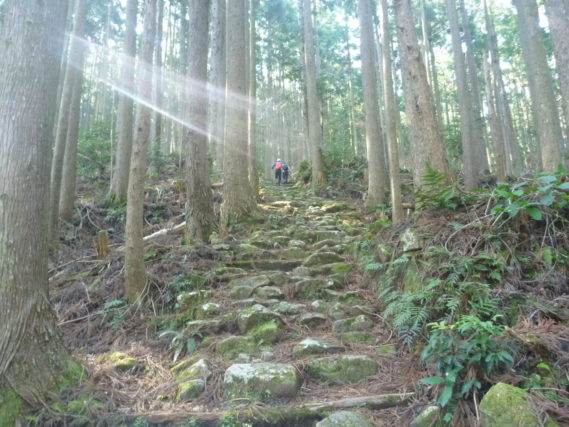
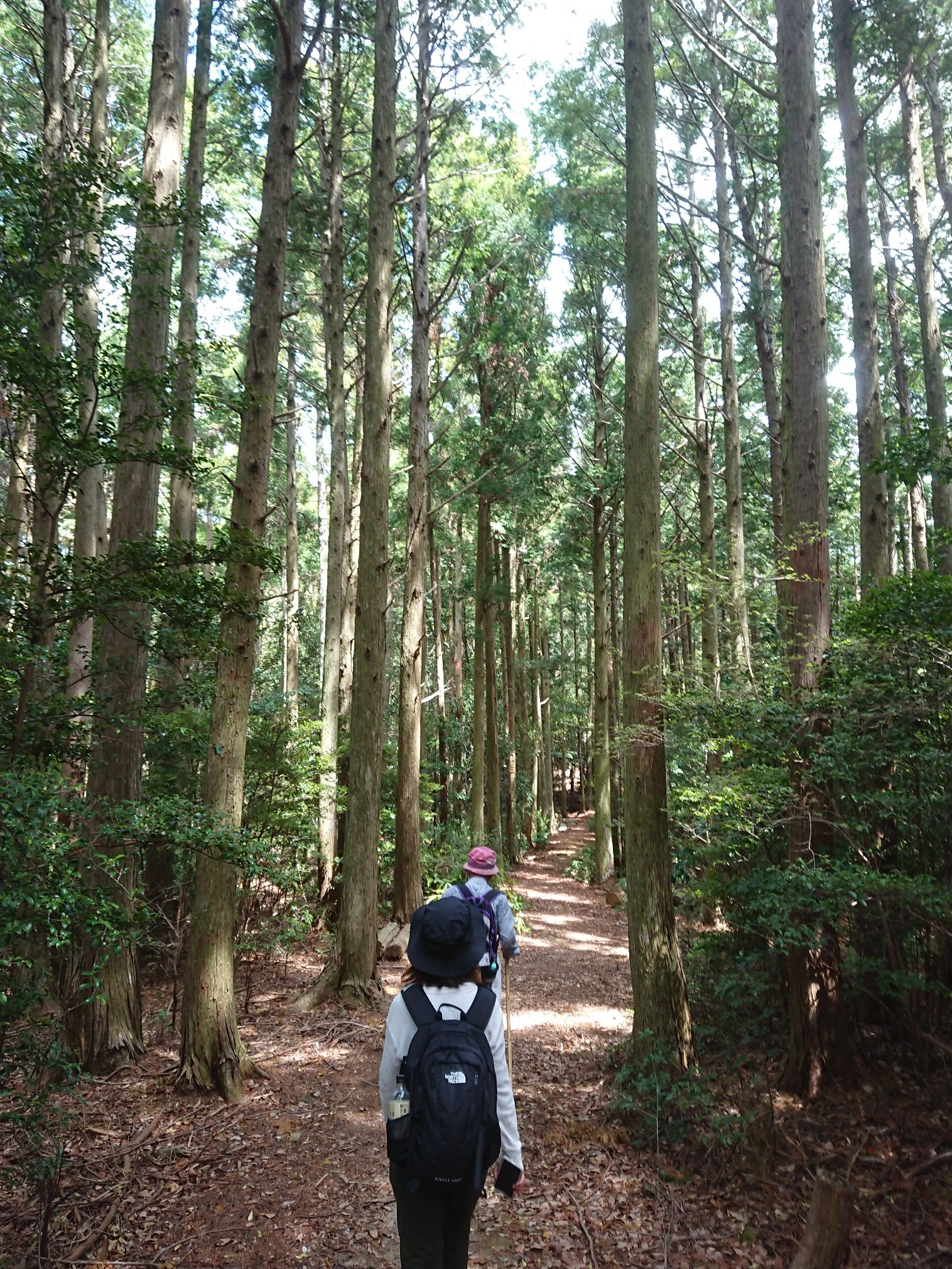
I had long planned to do a “one-stop walk” from Takijiri to Hongu Taisha.
The total distance was 37.8 km. I left Takijiri at 6:00 a.m. and arrived at Hongu Taisha at 4:10 p.m. It took about 10 hours.
The previous distance from Kogumotori-goe to Nachi Station was 34.4 km, so this time I broke the record.
This time, I had time to catch the bus, so I was fighting against time. So my pace was much faster than last time.
By the way, last time it was about 15 minutes for 1 km on the flat, but this time it was 12 minutes.
I climbed uphill with the method that a professional mountain photographer had taught me before. It took me 30minutes from Takijiri to Tsurugi-no-yama, 20 minutes to reach the Iwagami Pass, 14 minutes to reach Mikoshi Pass, and 6 minutes to climb Takkunzaka.
Thanks to that, my legs don’t seem to belong to me (laughs).
I went to Mihama Town – Yura for a preliminary inspection under the guidance of a member of our association.
First, we went to Shirasaki Marine Park, but gave up getting out of the car because of the stormy winds from the typhoon. Then we went to a mountain that members often climb.
It took us about an hour to reach the top, but the view was spectacular, offering a panoramic view of the Kii Channel.
After descending the mountain, we went around the Mio area and visited Hinomisaki cape.
The Mio district was a region where immigrants to Canada flourished, starting with Gihei Kuno, the first immigrant to Canada from the Mio district, in 1888.
When Gihei saw a large school of salmon moving up the Fraser River in Vancouver, he thought, “This is it! ” He was inspired by the idea.
Come to Canada, where the sarang (salmon) are swimming in layers!
Thus, the villagers went to Canada one after another.
The men fished for salmon, the women worked in salmon canneries, and they gained the trust of the locals.
However, the “glory” vanished with the Greater East Asia War.
Even in Canada, Japanese were captured as prisoners of war, and some 1,300 ships were destroyed.
As an activity to pass on the history of this immigration to future generations, the Mio district is working on a “junior storyteller” initiative, which is transmitted in English. I would like to hear about it once.
The emperor at this time was a woman, Emperor Shoutoku. At this time, there was a civil official named Wake-no-Kiyomaro. Before and during the war, Kusunoki Masashige was the military leader and Wake-no-Kiyomaro was the civil official.
Wake-no-Kiyomaro was also the face of banknotes.
Therefore, the Emperor asked Wake-no-Kiyomaro to confirm whether Dokyo really received such an entrustment at the Oita shrine.
Dokyo caught Wake-no Kiyomaro before he departed and said, “You know what kind of answer I need you to bring me, don’t you?” He threatened him.
If you disobey Dokyo, he does not know what will happen to his life.
Since Buddhism has the Buddha behind it, there was a fear that he would be punished by the Buddha and end up in hell….
Wake-no-Kiyomaro received an oracle at the shrine. The god said, “Such a thing is a complete lie. The most important thing is that the position of emperor has been passed down through the generations from Amaterasu to the present day, and that no one in power should ever assume the position of emperor”.
Kiyomaro returned to the Imperial Court and announced the situation in the presence of the Emperor, Dokyo, and many other officials.
The look of pride on Dokyo’s face, which had been triumphant until then, changed suddenly.
Because of this incident, Dokyo was forced to leave his position and was exiled.
Thus, the decision was made to protect a stable Japan centered on the original emperor.
Falsified data by the Ministry of Health, Labor and Welfare?
Again, this time about coronaviruses. Here are some excerpts from our member newsletter.
It appears that materials promoting vaccination were distributed to the general public in October of last year.
In the material, regarding the frequency of myocarditis caused by the new corona among teenagers and young people in their 20s, the MHLW put the number at “834 cases per million people”. However, only 4 people actually developed myocarditis.
Furthermore, we have included numbers in the 30s to give this figure. This shows the malicious intent of the government to blatantly promote vaccination of young people. This issue was finally pursued in the Diet on March 4 of this year. However, the Ministry of Health, Labor and Welfare only gave an unanswerable answer. https://nico.ms/sm40285607 (4:25)
Perhaps many families who received that flyer have decided to have their children vaccinated.
It is unfortunate.
So why did this happen? I think that is the important point.
Japan’s national budget is approximately 100 trillion yen. Of that amount, the general account for health care costs is approximately 50 trillion yen. Simply adding up special accounts, etc., it is said to be about 100 trillion yen.
This situation is extraordinary.
Even though so much money is being spent on medical care, instead of people becoming healthier, the number of cancer patients is increasing and the cost of medical care is also increasing.
The government uses its huge budget to buy vaccines in large quantities from major pharmaceutical companies at a cost of tens of trillions of yen.
Dr. Kazuhiro Nagao, a doctor in Amagasaki, whom we have mentioned in previous newsletters, has been receiving inquiries from people who have become ill after receiving daily vaccines. He says that he refuses to see people far away from his clinic for post-vaccine-related consultations because it interferes with his regular medical practice.
As we have reported before, most so-called “experts” in the media are paid by pharmaceutical companies. The professor in this video, Atsushi Otsuka, is one such person. Although the data is old, it is natural to assume that he probably received money last year and this year as well. Money Database Atsushi Otsuka, 2016-2018
Fat Vaccine Stockpile?
They have to “consume” this vaccine by all means because they are contractually prohibited from discarding it, even if it doesn’t work.
We do not know if the government really purchased this vaccine in anticipation of vaccinating people from the age of 5 and up. But if this is just a “stock clearance” …
The vaccine is still in the clinical trial stage. The true effectiveness of the vaccine will only be seen in the future. Children who still have a bright future ahead of them may have to suffer from the aftereffects of the vaccine for a long time to come.
However, I think it is a big step forward that each and every one of us is speaking out in this way and that the media is beginning to pick up on it.
There is much more I would like to say about vaccines, but that is enough for this issue.
The Heian Capital and the Japanese Political System①
This is a reminder of Zenko Onagi’s talk.
Under the Ritsuryo system, a system was established to unite the whole country using a network of shrines, including a system of stockpiling rice to help people survive in times of emergency, since Japan is prone to natural disasters.
After Buddhism entered Japan, however, a different system began to emerge, centered on temples. They began to have manors for temples, they began to receive many donations, they began to have financial power, and they began to have de facto power because they had many people under their control.
One of the founders of this period was a monk named Dōkyō. He was an extremely talented monk, who was able to answer the Emperor’s questions, make clear what was right and wrong, make decisions, and speak eloquently.
He also had a large number of subordinates, and gradually became a very powerful figure in the Imperial Court.
He should have remained committed to the emperor, but one day, at a shrine in Oita, he was told, “I should be the next emperor. One day, at a shrine in Oita, he began to say, “I have received an oracle that Japan will be safe if I am the next emperor”.
He was like Ashikaga Takauji (laugh).
At this point, no one could resist Dōkyō. The situation was such that the Imperial Court had to work completely according to Dōkyō’s wishes. In a sense, Dōkyō was the highest authority.
What was it that Dōkyō had lost his mind and decided to usurp the Imperial Throne?