
Many of you may say, “I hate snakes,” but there will always come a time when you will encounter them on the Kumano Kodo Trail.
If you dislike snakes physiologically, there is no way around it, but as a guide, I would like you to remember at least a few things about snakes.
Let’s get started.
Pit Viper
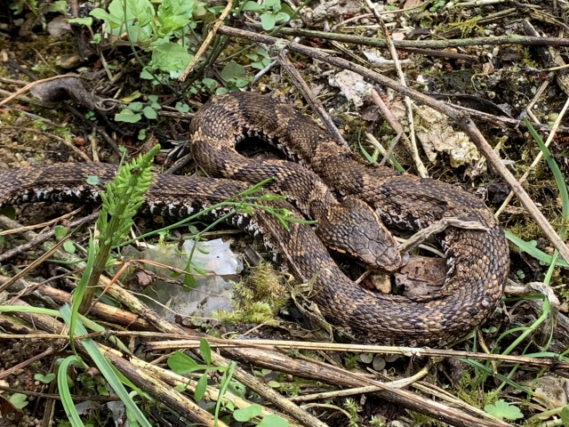
The most important snake to watch out for is the pit viper.
Although pit vipers are considered relatively mild, they will sometimes coil around and jump on you (this is only if you provoke them, though. (This is only in the case of stimulation. It could be the result of an unknowing passerby who “ stimulated” the pit viper.)
I was bitten by a pit viper when I was in elementary school and survived.
…In this case, it was my fault.
On my way home from school, “Boy Wada,” who used to play with snakes whenever I saw them, one day I saw a snake going into the grass.
I grabbed the snake by the tail to see what kind of snake it was, and when I lifted it up, I was bitten on the hand.
At first, the boy Wada did not know that there were poisonous snakes in Japan.
However, after being bitten, I felt a slightly different feeling and realized intuitively that I had been bitten by a “bad snake”.
When I came home, my father had just returned from a break at work. I told him that I had been bitten by a snake and showed him my hand, and he said, “You were bitten by a pit viper. Let’s go to the hospital right away,” and we ended up going to a hospital in Shirahama Town where I lived.
At this time, the middle finger of my right hand where I was bitten had already turned light purple and begun to swell.
We arrived at the hospital, but unfortunately that hospital did not have a serum and we had to go to the neighboring city of Tanabe.
They could have called an ambulance, but for some reason they did not, and my father drove us safely to the next hospital.
In the car, the boy Wada had difficulty breathing and thought to myself as a child, “I might die now”.
Arriving at the hospital, I fainted while being carried to the hospital room in a bed.
When I came to, I did not know if I was alive or if I had already died and was looking at the afterlife.
My right hand, where I was bitten, was swollen all the way up to my shoulder and my short-sleeved uniform shirt was torn by the doctor.
…It would be hard to have such an experience and I never want to do it again.
Then the boy Wada wondered if snakes had traumatized me …
Not at all.
Even now, I can grab snakes other than pit vipers with no problem, and I once killed a pit viper with a stone when I was walking along the Kumano Kodo (Kumano ancient road) because it was coiled around me and was about to attack me.
However, as expected, I don’t want to grab them with my bare hands anymore.
Tiger Keelback

Until recently, it was considered “nonpoisonous,” but it was found that its venomous fangs are located in the back of its mouth, and it was certified as a “ poisonous snake” in the clear.
The characteristic features of this snake are a yellow neck with a red and black block pattern, but since there is a large variation among individuals, some of them are black, and it is sometimes difficult to tell the difference between them.
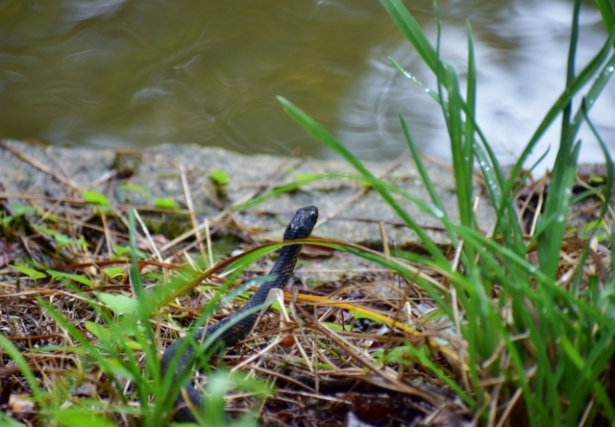
Although they are gentle in nature and there have not been many bite events (although in 2017, a boy in Hyogo was bitten by this), they are still a snake to watch out for.
The poison is also found in the “ jugular gland” on the back of the neck.
This is a defensive poison, and if you grab it, the poison sprays out.
If it gets into the eye, it causes severe pain and, in the worst case, blindness.
This poison seems to be accumulated by eating toads and is not present in individuals that do not eat toads.
What to do when bitten by a snake?
What should you do if you are bitten by a snake?
In the past, I read in a book, “Cut the wound with a knife, and if there is a river nearby, pour out the poison…” However, it is now said that actions such as “cutting the bite spot,” “tying the bitten arm,” and “sucking out the poison” are instead counterproductive.
However, some hospitals recommend “cutting, suctioning, and tying” and it is difficult to judge.
It is said that immediately after being bitten by a poisonous snake, the venom has already dispersed into the tissues of the cells, so sucking out the venom by sucking out the blood will not be as effective as it should be.
…Come to think of it, the boy Wada also survived without such treatment.
So, the best way to do it seems to be to “keep at rest and call the ambulance service immediately”.
If you walk and raise the heart beat, that will speed up the poison’s circulation.
It is also necessary to calm the injured person.
It is important to calm them down and say “I’m fine” so that they do not raise their heart beat due to psychological anxiety.
But in recent years, some have insisted on seeing the doctor as soon as possible, even if it means running, which is a controversial issue.
It is also important to remember what kind of snake bites you and its characteristics.
This is because the way to deal with the bite will depend on the snake that bit you.
In the unlikely event that you are unable to confirm its appearance, there are ways to see what symptoms it may cause.
In the case of pit viper bites, symptoms of swelling are seen immediately, as in the case of the boy Wada.
In the case of a tiger keel back, as in the case of the Hyogo boy, bleeding does not stop and headaches occur. There does not seem to be much swelling.
For your reference, the boy Wada was discharged from the hospital about 2 weeks after I was hospitalized for the bite.
During that time, the treatment (daily intravenous drip + big injection every morning) and the surgery to sew up the broken necrotic part were painful.
I still remember that during the surgery, I cried and screamed until the anesthesia took effect.
Snakes that are not dangerous
In Honshu, there are only the above two types of poisonous snakes.
However, there are other snakes, and if you have a way to confirm whether they are venomous or not, you will not be unnecessarily frightened, so I will introduce them here.
Four-lined Ratsnake
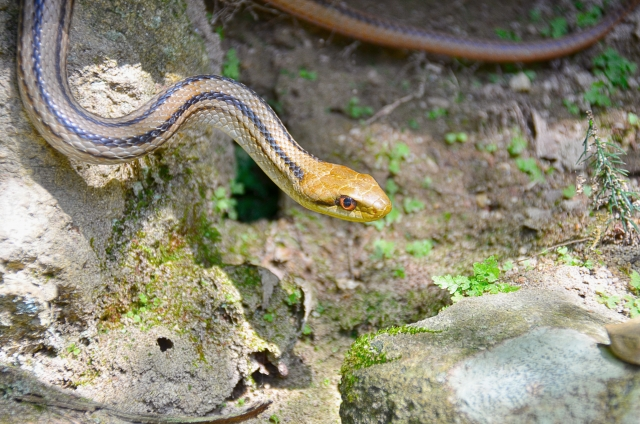
Probably the most common snake seen in Kumano Kodo.
It has a rough temperament.
Once, while walking with a client, it jumped at me when the client poked it with a trekking pole.
As its name suggests, the striped snake has stripes on its body.
However, there are many individual differences between these snakes as well, and it can be difficult to tell them apart.
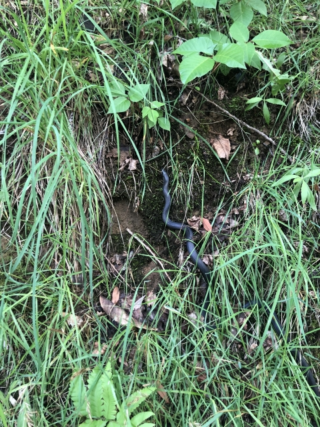
I have been bitten by this one, and it seemed to have saw-like fangs that went deep into my finger.
I bled quite a bit.
Even though it is not poisonous, it seems that it catches its prey effectively by making its fangs in such a shape.
Ratsnake

They look much like Four-lined Ratsnake, but they are larger than thme, with some reaching up to 2 meters in length.
When I went mountain stream fishing deep in the mountains, I once encountered a huge one whose body was more than 5 cm in diameter. It was too big to see the whole thing, but since there are no giant snakes in Japan, I think it was probably a giant version of this one.
The aodaiso also has stripes, but they are more indistinct than those of the striped snake, and the body color is greenish.
The decisive difference is the color of their eyes.
Four-striped Ratsnake’s are reddish, while Ratsnake’s are olive (brown).
However, this feature can only be seen up close, so I don’t think it is a good way to tell them apart.
Burrowing Ratsnake
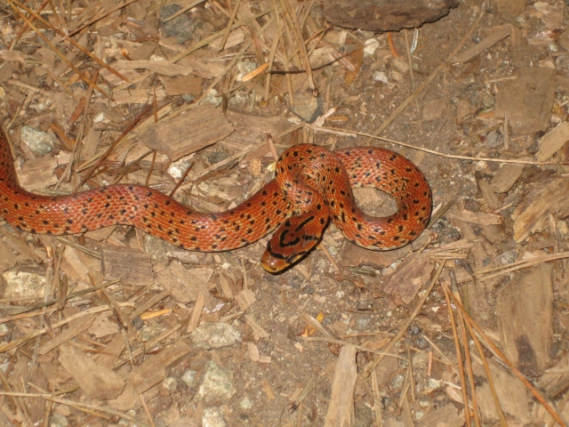
Although it may look like a showy, venomous snake, this one is not poisonous.
In its juvenile stage, the snake is bright reddish in color, but as it grows, the reddish color fades and becomes brownish.
However, there are individual differences among these snakes as well, and some are difficult to judge in general.
As they are called “burrowing ratsnakes,” they seem to like burrows and are good at digging.
I have seen this one several times in Kogumotorigoe.
One time, a guest found one with its head in a gap between two rocks, and there was a small commotion.
The guest said confidently, “That’s definitely a venomous snake, isn’t it?”
I was once given a dubious look when I replied, “No, it’s not”.
My first “encounter” with this snake was when I was walking in the Hatenashi Mountains, and I almost stepped on one.
At that time, it was wagging its tail and making noises in a threatening manner, just like a rattlesnake, so I thought, “Oh my God, does this one have poison? ”
Anyway, I calmed it down and had it go away.
When I got home, I checked it out and found that it was not poisonous…
Japanese Keelback
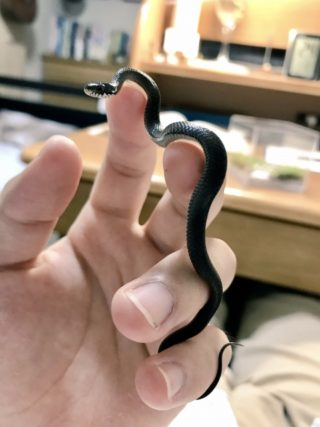
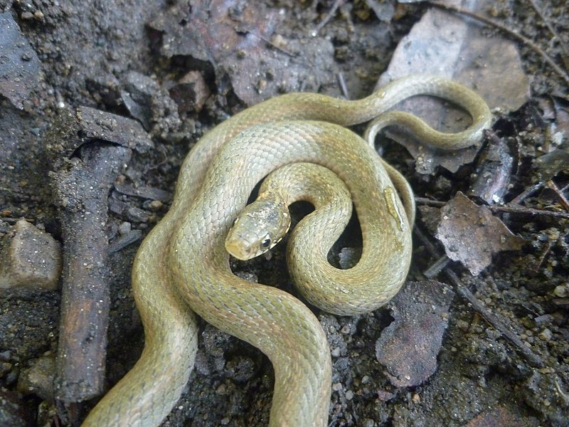
I saw this one while walking along the Kumano Kodo Kohechi trail, so I am adding it to the list.
The individual in the photo is quite small, but even if it grows up to about 60 cm at most, it is a small snake.
The one we saw was about 40 cm.
We could not get a good look at it because it was running away so fast, but the mountain guide said so, so I am sure of it.
We saw two of them while we were walking.
The Japanese name “hibakari” comes from the phrase “if you are bitten, you live only a day,” and they used to be thought of as poisonous snakes.
If you see a snake
If you see a snake, the only thing you can do is “just stay away from it and don’t stimulate it.
Snakes bite as a last defense measure, and they are not like some humans who like to fight with each other.
If you remain a little calm, the snakes will leave you.
Also, you need to be careful not to go into the bushes, and to watch your step so that you do not accidentally step on a snake.
That is all for now.
I hope this will be of some help to you.